
Search behaviour is evolving, and AI Overviews are often appearing at the top of many Google results. These AI-generated summaries aim to answer questions directly in the search page.
It’s natural for vet clinics to wonder:
If Google is answering questions itself, will people still click on ads?
Is this why conversions feel different?
Here’s the reassuring reality:
AI Overviews change how people interact with search but they don’t eliminate the value of ads or your clinic’s visibility.
In fact, for most vet clinics, Google Ads should still be an essential part of your online strategy.
How AI overviews fit into search
AI Overviews often appear on broader or informational searches, such as:
- “Why is my dog limping?”
- “Best foods for senior cats”
- “Signs of dental disease in dogs”
In these cases, Google may summarise general information before showing traditional results.
Research from Pew Research Center found that when AI summaries are present, users are less likely to click on traditional links, however, this effect is concentrated on informational queries, where users are seeking an answer and not ready to act.
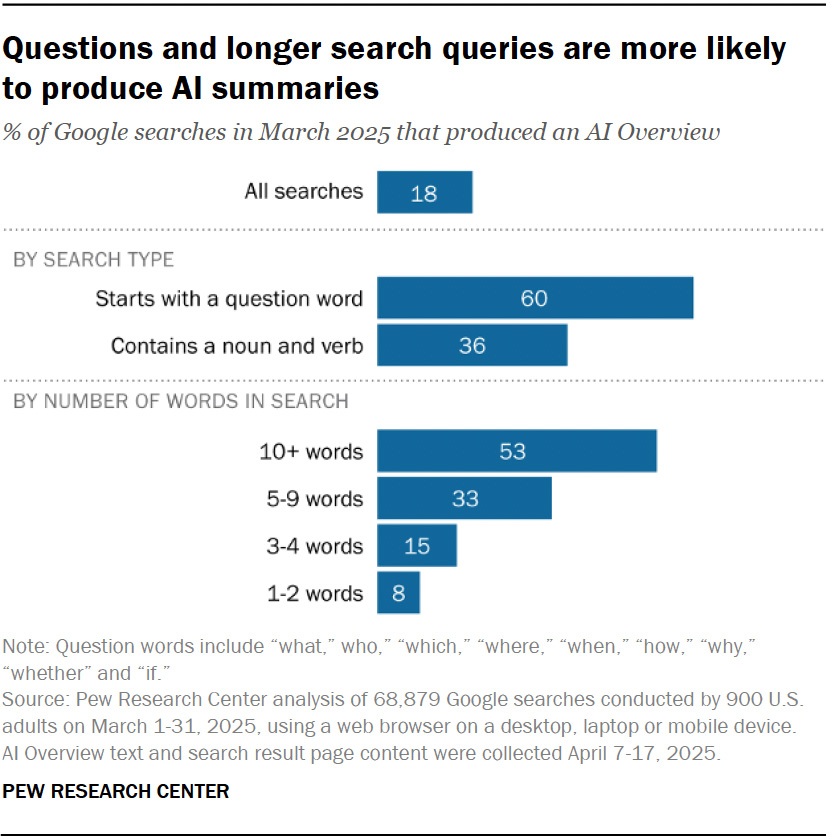
Source: Pew Research Center
The key point is this:
AI Overviews primarily influence early exploration, not decisions to take action.
For high-intent searches, like finding a local vet or booking an appointment, traditional search behaviour (including Google ads and clicks) still plays a major role.
Given that veterinary demand is largely reactive, these kinds of searches represent pet owners actively seeking immediate care.
Search click behaviour has shifted but not disappeared
Beyond AI Overviews, broader search behaviour is evolving.
Recent clickstream analysis from SparkToro and Similarweb (2024) found that more than half of Google searches now end without a click to an external website, particularly for informational queries.
In practical terms, when Google provides immediate answers to broad, informational queries, some users satisfy their curiosity without clicking through.
That means the users who perform follow up searches and click, especially on ads, are often further along in their decision-making process.
This can result in:
- fewer low-intent “research” clicks
- a higher proportion of action-ready users
- shifts in cost-per-click or cost-per-conversion metrics
Taken together, these trends and observations help explain why some clinics may notice changes in clicks, impressions or conversion patterns.
But here’s some reassurance, these shifts are most pronounced for purely informational searches.
When someone searches with clear intent, such as “vet near me,” “emergency vet open now,” or “book dog dental appointment”, they still click, engage and convert.
AI can answer questions. It cannot replace the moment when a pet owner decides to act.
Why Google Ads still matter for vet clinics
Even when AI Overviews appear, paid ads and local listings continue to show on the search page.
In many cases, an AI summary simply gives context, which can make the user’s next step clearer, such as seeking care from a local provider.
For example:
A pet owner reads an AI summary about dental disease risks.
Then they search for “dog dental vet near me.”
At this point, they’re looking to act so Google ads and local listings (like Google Business Profile) become the pathway to that action.
AI can inform, but it cannot:
- diagnose
- treat
- book appointments
- replace the trust built by a known local clinic
Your clinic is still the solution in those moments.
Why some clinics see higher costs or lower conversions
We have seen in other industries that automated ad features designed to broaden reach, including ones that can qualify for experimental AI contexts, have delivered:
- broader, less relevant traffic
- higher conversion costs
- weaker signal between intent and action
This means that wider placements can increase visibility, but not always relevant engagements.
For vet clinics, we continue to recommend campaigns tightly focused on:
- local intent
- appointment or call-focused keywords
- strong ad relevance and aligned landing page experiences
The goal isn’t to appear everywhere.
It’s to appear where people are ready to take action.
What this means for your clinic
The bottom line is simple:
AI Overviews don’t replace the value of Google Ads.
They alter the early stages of search behaviour, but they don’t remove clicks from high-intent users, the users who are most likely to book or call.
In other words:
Google Ads capture reactive demand.
Strong online presence and content supports exploratory demand.
If anything, AI summarisation often increases awareness, which can strengthen motivation to take the next step like a call, a booking, or an appointment request.
The clinics that continue to perform well in Google Ads are those that:
- prioritise intent-driven keywords
- track real conversions (calls and bookings)
- optimise landing pages for action
- maintain strong local relevance and messaging
Ads continue to be one of the most effective ways to capture demand at the moment it exists.
For clinics with well-managed campaigns, sound keyword strategies and clear conversion goals, Google Ads remains a critical way to turn search interest into real bookings.